
Find Marion County Residents
Choose the first roll by the information in hand. An address points to the Marion County Assessor and MapIndy. A person’s name can be checked in the assessor, the recorder’s party index, Indiana MyCase, or a historical city directory. A case number belongs in MyCase, while an old book and page belong in the recorder system. Each source proves something different. A parcel card identifies the tax-roll owner, not every occupant. A court result identifies a party in one case, not a current home.
A strong Marion County residents directory search records the spelling, date, source, and geographic label for every hit. Indianapolis and Marion County share a consolidated government, yet the recorder, clerk, assessor, health department, courts, and elections office remain separate custodians.
- Search the assessor by owner name or address, then save the parcel number and situs address.
- Compare the name in MyCase and the Indiana voter-status system, using dates and middle names where available.
- Use the recorder’s exact party-name search to locate deeds, mortgages, liens, or other instruments.
- For an earlier decade, check the Indianapolis city directory run and related maps.
- Ask the correct custodian for a copy or file an Indiana APRA request when the online trail stops.
Marion County Directory Custodians
The Recorder keeps permanent real-estate instruments, including deeds, mortgages, plats, easements, liens, releases, and surveys. The Assessor publishes property report cards and owner searches. The Clerk handles marriage licenses, court-file copies, divorce records, and probate-related material, while MyCase supplies the public statewide court index. Election records and current vote-center information have their own county and state routes. For a full address-led method, use the Marion County street directory.
Marion County Recorder
200 E. Washington Street, Room 741
Indianapolis, IN 46204
(317) 327-4020
Indiana’s Access to Public Records Act, IC 5-14-3, is the general fallback. A request may be oral or written. The documented acknowledgment periods are 24 hours for an in-person or telephone request and seven calendar days for one sent by mail, fax, or email. APRA does not require an office to create a new resident list, and it does not override a law that makes a record confidential.
Search Marion Property Cards
The Marion County Assessor Property Report Cards portal offers four practical entry points. Partial owner names work, which helps when an initial or business suffix is uncertain. An address search uses suggestions. Parcel mode expects seven digits, and state parcel mode accepts an 18-digit identifier beginning with 49. Once a card opens, the page can supply the situs address, mailing address, township, tax district, plat, legal description, transfer rows, assessed values, and parcel characteristics.
| Assessor field | How Marion County uses it |
|---|---|
| Owner Name | All or part of the tax-roll owner name |
| Address | Property address selected from autocomplete suggestions |
| Parcel Number | Seven-digit county parcel identifier |
| State Parcel Number | 18-digit or formatted Indiana parcel identifier |
After the assessor search, open the Marion County Recorder office page shown below for the recorded-document custodian and access route.
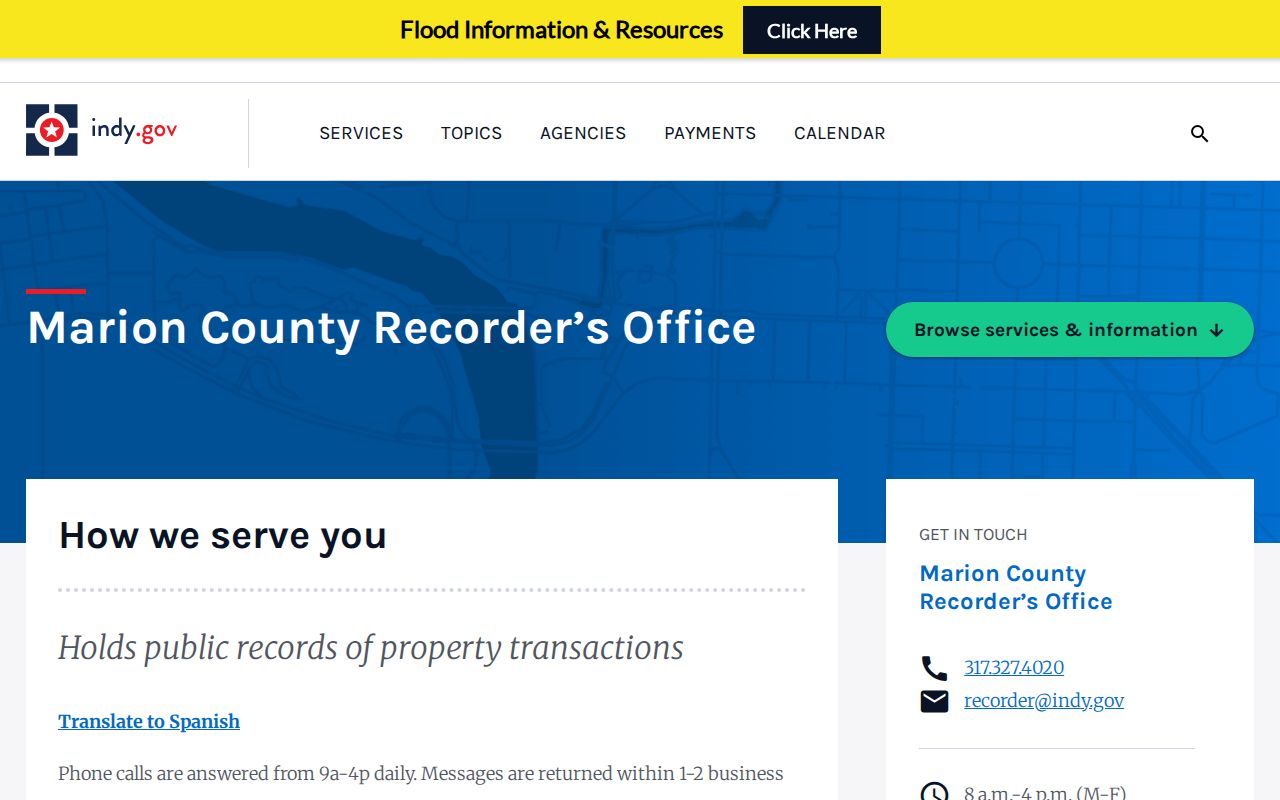
The office page is the reliable route for recorder contacts and changes in access, while the assessor portal remains the address and parcel starting point.
Read Marion County Record Terms
Official systems use short labels that can change the meaning of a result. Define the term before matching the person.
- Parcel
- A mapped unit of land with a county identifier; one street address may involve more than one parcel.
- Index
- A finding aid that points to a record. It may not include the signed image or certified copy.
- Roll
- A maintained list for one official purpose, such as assessment or voter registration.
- Criss-cross directory
- A directory arranged by street and house number rather than only by surname.
A Marion County residents directory is therefore a workflow across several indexes and rolls. The source date matters. A deed party from years ago, a current tax-mail recipient, and a voter registration entry can all refer to different points in one address history.
Current Marion Resident Rolls
Current official sources are narrow by design. The assessor covers owners and tax-mail contacts. The recorder lists parties tied to recorded instruments. MyCase lists public case parties. Indiana’s voter system serves registration and election administration, with protected fields and protected voters excluded as the law requires. MapIndy adds geographic context but does not identify every person in a dwelling.
| Marion source | People represented | Best use | Access route |
|---|---|---|---|
| Property Report Cards | Owners and mailing contacts | Connect a name with a parcel | Free online search |
| Recorder DirectSearch | Parties to recorded documents | Follow deeds, liens, and releases | Free index; counter and terminals |
| Indiana MyCase | Parties in public court matters | Confirm a case-linked identity | Free index; Clerk for copies |
| Indiana Voters | Registered voters | Check status and election details | Public portal; statutory limits |
| Registered Organizations GIS | Community organizations, not members | Identify the group serving a block | Public map and GIS layer |
Commercial people-finder results may merge old addresses and names from mixed sources. Official records are slower to compare, but each has a named custodian, stated purpose, and route to a certified or source record. Neither category should be treated as proof without checking dates and the original office.
Verify Marion Names in MyCase
Indiana MyCase searches by case, name, or attorney. Name search includes person or business controls, exact or sounds-like choices, filing date, case status, court, and case type. Results can show the case number, court, caption, filing date, case type, status, parties, attorneys, charges, events, and disposition information when public. The system limits broad result sets and may use CAPTCHA.
A docket is the court’s event list for a case. It does not mean every filed document is online. Older material, certified copies, and some public documents must come from the Marion County Clerk. Sealed, juvenile, adoption, and expunged matters remain restricted. Match the court result to another anchor, such as an address, age, middle name, or related case fact, before deciding it belongs to the resident sought.
The captured Indiana MyCase screen shows the official search entry used for a Marion County name check.
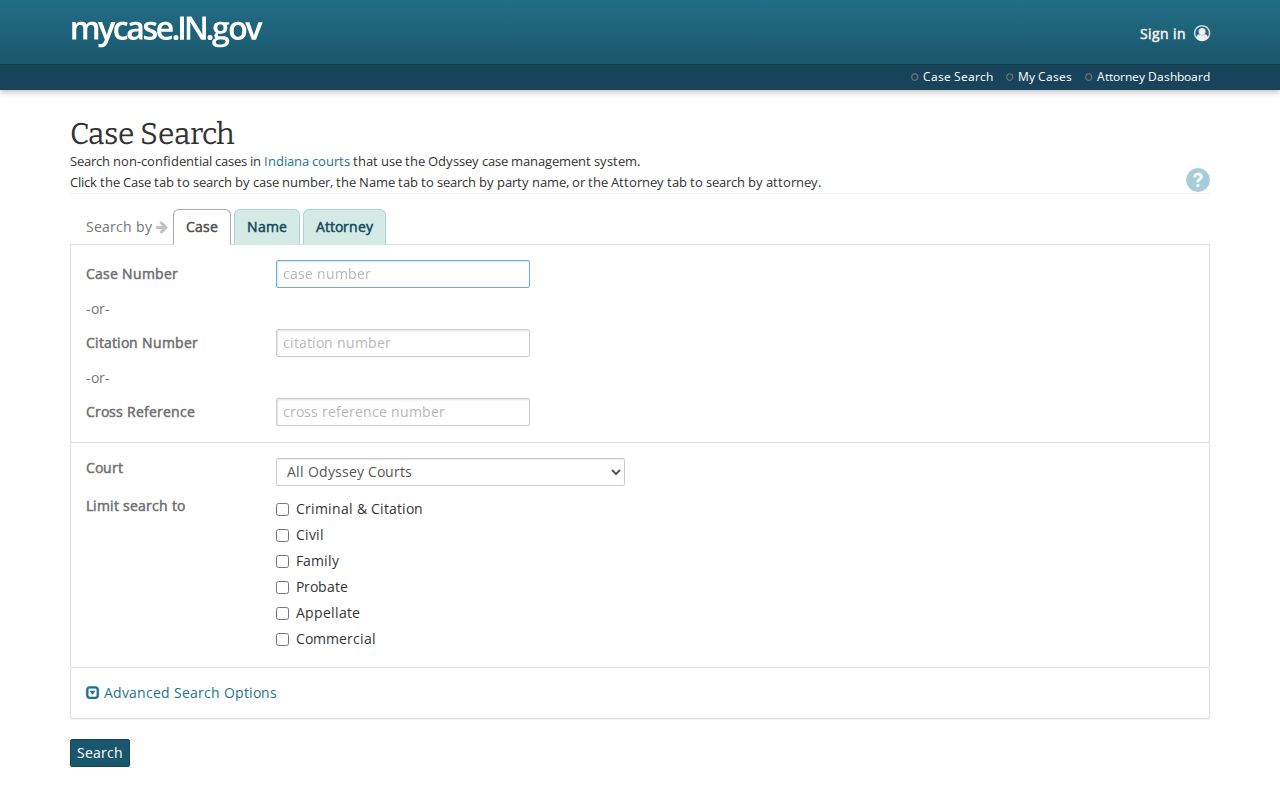
The court index can confirm involvement in a public case, but the clerk remains the record custodian.
Check Marion Voter Records Carefully
The Indiana Voters portal is the official status and election-information route. A separate full-list request uses VRG-24 and county submission. That list is subject to purchaser eligibility, payment, an anti-solicitation agreement, redaction, and protected-voter rules. Indiana’s April 2026 voter guidebook updates the public and confidential split, electronic-copy rules, maintenance retention, and use limits.
A voter nonmatch does not show that a person is absent from Marion County. The resident may not be registered, may have moved, may be indexed differently, or may participate in Safe at Home. Qualified participants in that address-confidentiality program use a substitute legal address and receive protected voter-record treatment. Search results must never be used to stalk or harass anyone.
The captured Indiana Voters portal is the correct starting point for current registration information.
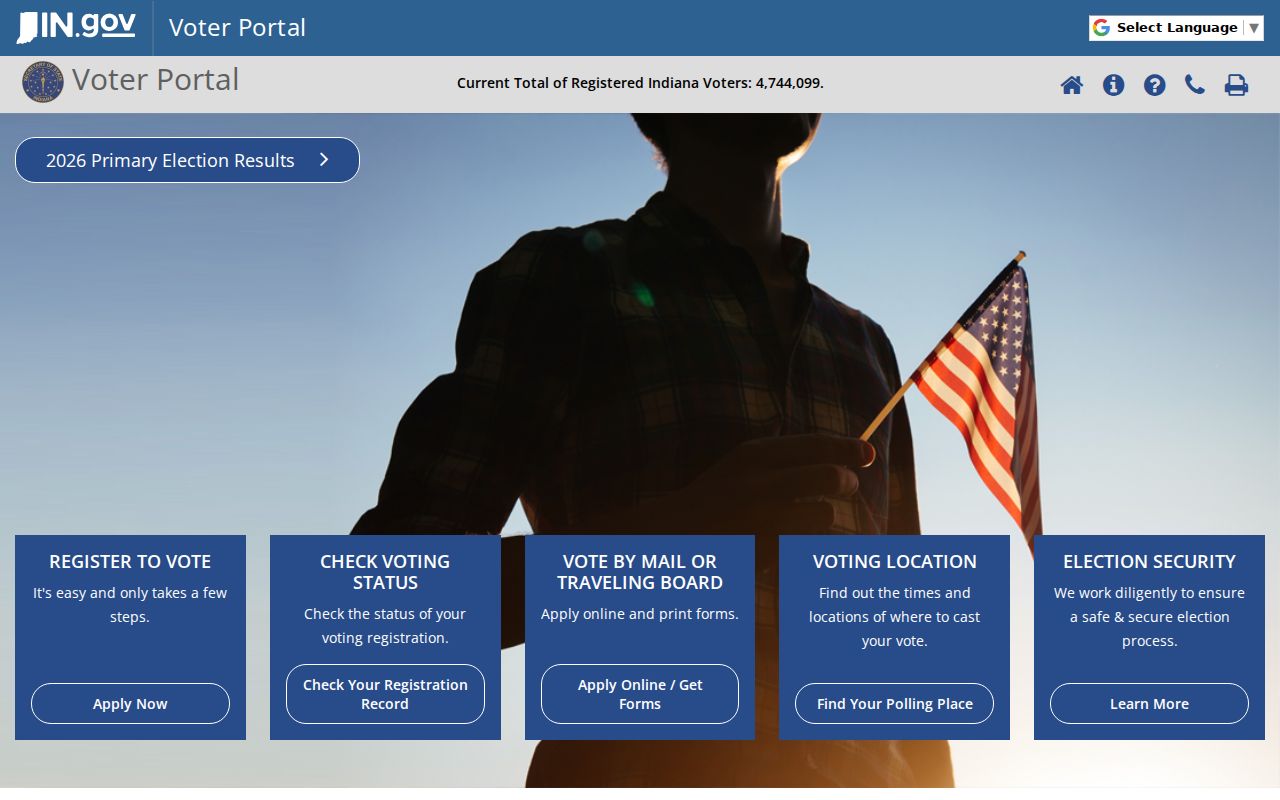
Election dates and vote centers change, so current details should be checked through Vote Indy for each election.
Search Marion Deed Parties
The Recorder’s Fidlar DirectSearch does not work like the assessor. Its live public settings favor exact party name, document type, recording dates, document number, and subdivision lot or block. Address and parcel searches are disabled. Wildcards are not enabled, and current index information may lag recording by about five days. Result rows can show document type, recorded date, Party1, Party2, and legal-description information.
Start with the owner spelling from the property card. Search the last name exactly as indexed, add the first and middle names in the first-name field, then narrow by deed or another document type and date. If images are unavailable, use the office terminals or request the record. The historical guide reaches back to 1821 and explains book codes such as DE for deed, MG for mortgage, and LN for lien. Early book-and-page records need exact formatted references, while 1950 through March 31, 1964 uses an A plus year and instrument-number pattern.
This is an insider distinction: the free index finds a citation, while the recorder supplies the official instrument and any certified copy.
Open Marion Vital Record Doors
Birth, death, marriage, divorce, and adoption information do not share one public name index. Indiana Department of Health holds state birth records from October 1907 and death records from 1900. Earlier events are local. Recent certificates require identity and direct interest under Indiana law. State guidance allows genealogy access when the event is more than 75 years old and the named person is deceased.
IDOH accepts mail, phone, local walk-in, and its authorized online vendor route. Marion County Public Health provides local service. Marriage licenses belong to the county clerk, and the state marriage-license public lookup contains many, but not all, licenses from 1993 forward. Divorce records are court and clerk records. Adoption files are sealed, but Indiana’s official Adoption Matching Registry and consent forms create a lawful route for eligible adoption-history requests and contact preferences.
Fees differ by record and route. Use the current application and custodian page rather than copying an amount from an old form. A failed online lookup should lead to the local counter, clerk request, Indiana Archives, State Library microfilm, or a narrow APRA request, depending on the record.
Explore Marion Historical Directories
Indianapolis city directories form one of the strongest long-term Marion County resident trails. The official collection links published directories from 1855 through 2001, while suburban directories begin in 1957. Entries may list a householder, spouse or widow notation, occupation, employer, and street address. Later criss-cross volumes let a researcher reverse the order and begin with the address.
The Marion County city directory collections deserve their own year-by-year search. For a quick home-page check, compare the same surname in adjacent volumes and note every abbreviation exactly. Then pair the directory year with census, obituary, deed, and map evidence. IndyPL Central and Special Collections, the IU Indianapolis digital collection, the Indiana Historical Society, Indiana State Library, and Genealogical Society of Marion County provide different shelves and staff help.
Maps correct a common failure. Indianapolis changed addresses in 1887, 1899, and 1916, and renamed Tennessee Street as Capitol Avenue and Mississippi Street as Senate Avenue in 1895. A person may appear to vanish when only the street label changed.
Bridge Marion Record Eras
Marion County’s surviving books reach into the county’s first years. The county was organized in 1822, and the State Library guide identifies Deed Book A for 1822 to 1827, early probate books, marriage material beginning in 1822, and later WPA indexes. Those WPA tools cover marriage, birth, and death periods that do not line up neatly with today’s state vital-record system.
The record trail then moves through original books, handwritten indexes, microfilm, printed city directories, recorder images, court-system conversions, and current GIS data. That layered history explains why “not online” does not mean “no record.” Ask where the file moved, whether microfilm exists, and whether the clerk’s Old Records unit, Indiana Archives, State Library, or local genealogy collection holds a duplicate.
A June 25, 2025 Indianapolis Public Records Commission agenda included destruction notices from the Assessor, Recorder, Health Department, and other offices. The notice does not prove that every listed record was destroyed. It does show why retention status and transfer location belong in a serious search.
Use Marion Specialty Lookups
Some searches belong outside the usual property and court path. The Marion jail workflow and Indiana Department of Correction locator identify people in custody within their stated systems. Indiana’s Professional Licensing Agency offers real-time verification by profession, license type or status, name, city, county, and ZIP. INBiz searches business entities, names, registered agents, incorporators, and addresses. Indiana Unclaimed Property offers a free search and claim route.
The state license screen is useful when a person’s public professional record is the known fact.
Open Indiana professional license verification to use the official search shown below.
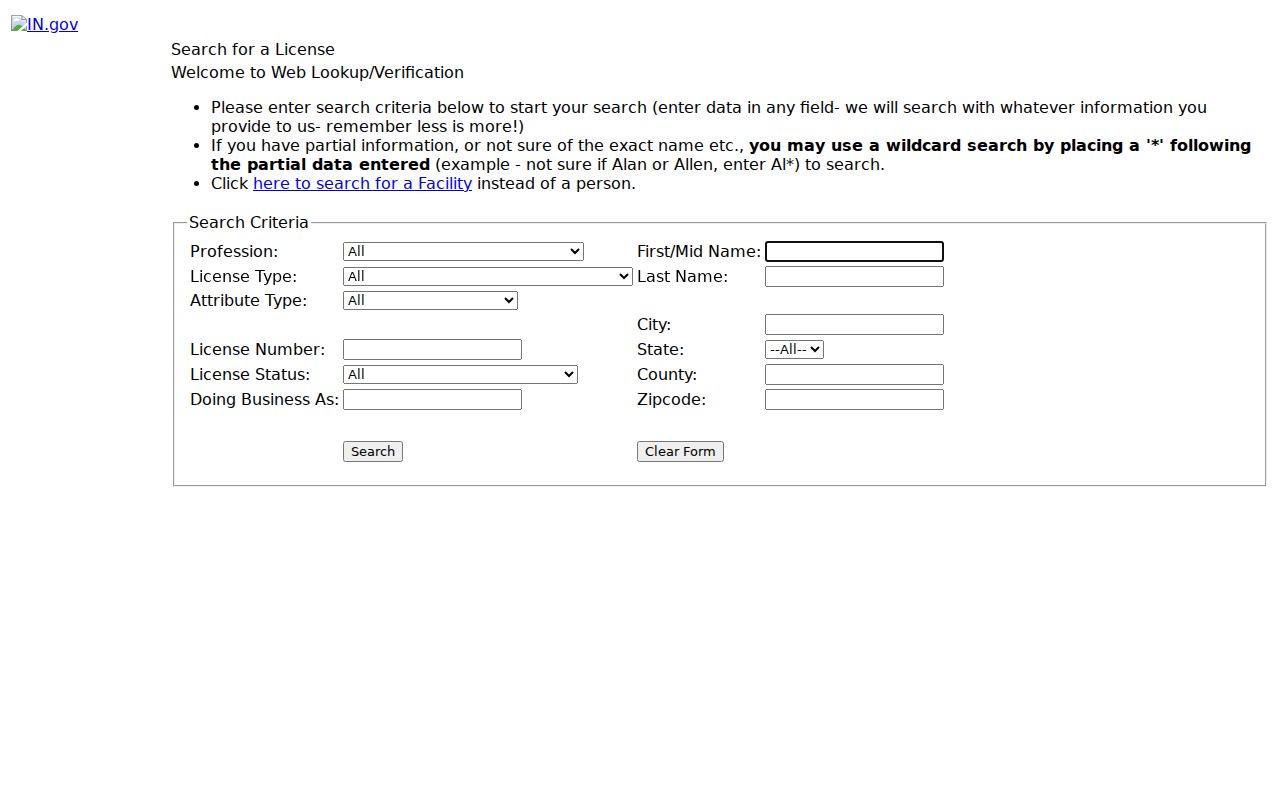
A license result confirms only the credential and status reported by the licensing agency. It should not be stretched into proof of a home address.
Respect Marion Directory Boundaries
Public does not mean unrestricted. Safe at Home substitute addresses, sealed and expunged cases, juvenile and adoption records, sensitive voter fields, recent vital certificates, and protected vehicle information have separate rules. The Indiana Consumer Data Protection Act took effect for enforcement on January 1, 2026 and gives rights involving qualifying covered businesses, but public agencies are outside that law’s coverage. It does not replace APRA or record-specific statutes.
Record-related scams often borrow a real name or case detail. Verify a deed mailing with the Recorder, a court demand with the Clerk, and a certificate vendor through IDOH. Officials do not validate an unsolicited demand merely because the caller knows an address. Keep the source URL, record date, and office contact with every saved result, then confirm important facts directly with the custodian.